
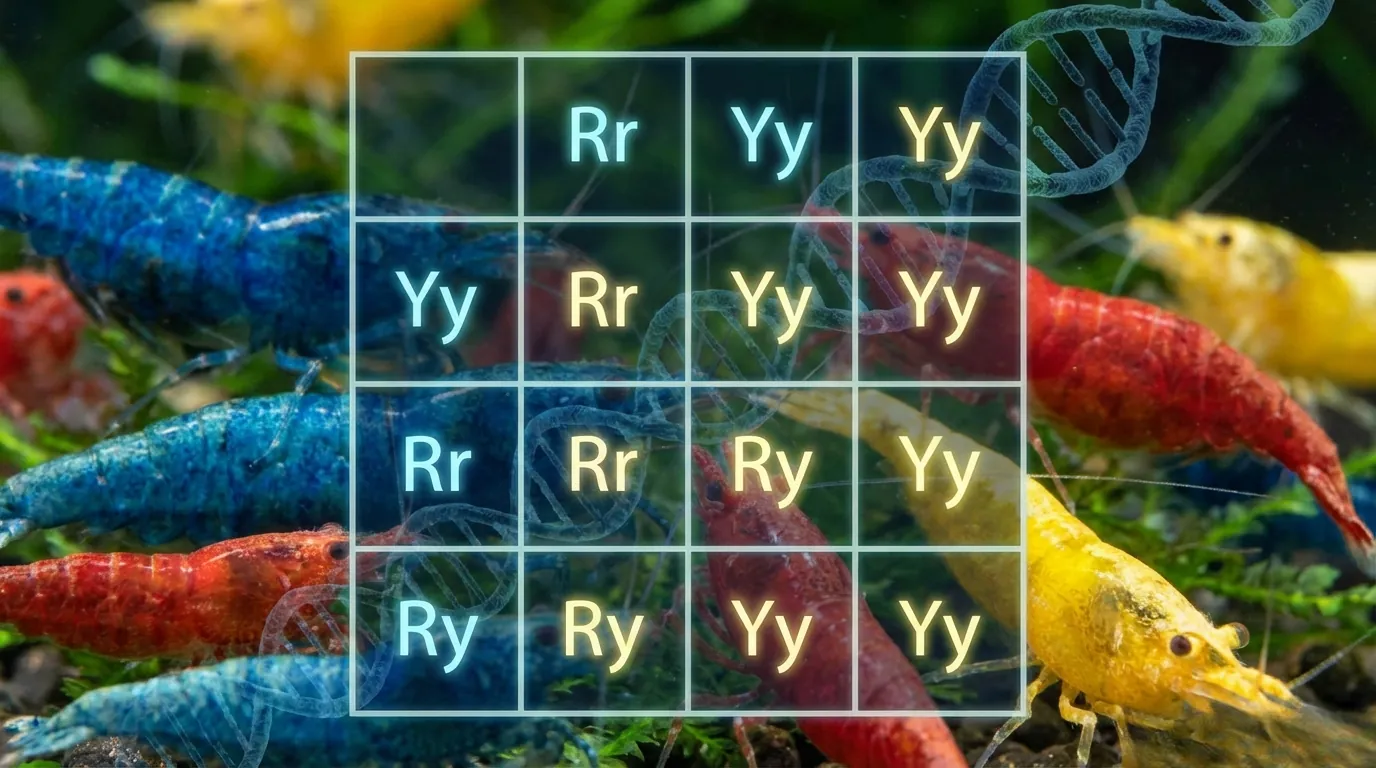
Understanding the basics of shrimp genetics is key for anyone interested in breeding specific colors, patterns, or improving the quality of their shrimp lines. While shrimp genetics can become complex, this guide covers the fundamental concepts relevant to hobbyists.
(New to breeding? See Setting Up a Breeding Tank)
Core Concepts
- Genes: Units of heredity transferred from parent to offspring, determining characteristics.
- Alleles: Different forms of the same gene (e.g., allele for red color vs. allele for wild color).
- Dominant Allele: An allele that expresses its trait even if only one copy is present.
- Recessive Allele: An allele that only expresses its trait if two copies are present (no dominant allele).
- Genotype: The actual genetic makeup of an organism (e.g., RR, Rr, rr).
- Phenotype: The observable physical characteristic resulting from the genotype (e.g., Red color, Wild color).
- Homozygous: Having two identical alleles for a trait (e.g., RR or rr).
- Heterozygous: Having two different alleles for a trait (e.g., Rr).
Simple Mendelian Inheritance (Example: Red Cherry Shrimp)
Let’s use a simplified example often applied to Red Cherry Shrimp (Neocaridina davidi) color versus the wild type (often brownish/clear).
-
Assume Red (R) is dominant over Wild type (r).
-
Possible Genotypes & Phenotypes:
- RR (Homozygous Dominant): Phenotype = Red
- Rr (Heterozygous): Phenotype = Red (because R is dominant)
- rr (Homozygous Recessive): Phenotype = Wild Type
-
Breeding Outcomes (Punnett Square Examples):
- RR (Red) x rr (Wild): All offspring will be Rr (Phenotype: Red)
- Rr (Red) x Rr (Red): Offspring ratio approx. 1 RR (Red) : 2 Rr (Red) : 1 rr (Wild) -> 75% Red, 25% Wild
- Rr (Red) x rr (Wild): Offspring ratio approx. 1 Rr (Red) : 1 rr (Wild) -> 50% Red, 50% Wild
This explains why breeding two Red Cherry Shrimp (especially if heterozygous Rr) can sometimes produce wild-type offspring.
Caridina Genetics (More Complex)
Caridina species (like Crystal Reds, Blacks, Taiwan Bees) often involve more complex interactions and multiple genes influencing color and pattern.
- Crystal Red (CRS) / Crystal Black (CBS): These are often considered variations of the same base pattern gene. Sometimes black is dominant or co-dominant over red.
- Breeding CRS x CBS often yields a mix of CRS and CBS, depending on the parents’ genetics.
- Taiwan Bees (Pandas, King Kongs, Blue Bolts, Wine Reds): These arose from mutations within Bee Shrimp lines. Many Taiwan Bee traits are recessive.
- This means a Bee Shrimp might carry the gene for a Taiwan Bee pattern (heterozygous) but not show it.
- Breeding two Bee Shrimp that both carry the recessive Taiwan Bee gene can produce Taiwan Bee offspring (e.g., 25% chance if both parents are heterozygous for a simple recessive trait).
- Breeding Taiwan Bee x Taiwan Bee will generally produce only Taiwan Bee offspring (as they are homozygous recessive for that trait).
- Breeding Taiwan Bee x regular Bee (not carrying the gene) will result in offspring that look like regular Bees but carry the Taiwan Bee gene.
- Grading: High grades (SSS, SS) in CRS/CBS often involve selecting for genes that control the intensity, opacity, and distribution of white pigment.
(See CRS Breeding Guide)
Selective Breeding & Line Breeding
- Selective Breeding: Choosing shrimp with desirable traits (color intensity, pattern, size) to breed together, aiming to enhance those traits in the offspring over generations.
- Line Breeding: A form of selective breeding focusing on reinforcing traits within a specific lineage, sometimes involving breeding related individuals (e.g., back-crossing offspring to a parent) to fix desired genes. Requires careful management to avoid negative effects of inbreeding.
- (See Line Breeding Guide)
Crossbreeding
- Neocaridina: Different color morphs of Neocaridina davidi (Red Cherry, Yellow, Blue Velvet, etc.) will interbreed. Offspring often revert to a less desirable brownish/wild type color over generations if different colors are mixed.
- Caridina: Some Caridina species can interbreed (e.g., CRS/CBS with Tiger Shrimp), creating hybrids like Tibees (Tiger x Bee). Taiwan Bees are also interbreedable with other Bees.
- Neocaridina x Caridina: These two groups generally cannot interbreed successfully.
(See Cross-Contamination Guide)
Key Takeaways for Hobbyists
- Dominant vs. Recessive: Understanding this helps predict potential offspring outcomes.
- Separation: Keep different Neocaridina color morphs separate if you want to maintain color purity.
- Caridina Complexity: Be aware that Caridina genetics (especially Taiwan Bees) are often recessive and more complex.
- Selective Breeding: Choose breeding stock carefully to improve or maintain desired traits.
- Patience: Genetic improvement takes time and multiple generations.
Conclusion
While delving deep into shrimp genetics can be complex, understanding the basic principles of dominant/recessive traits, genotypes vs. phenotypes, and the potential for crossbreeding empowers hobbyists to make informed decisions when selecting, breeding, and maintaining their shrimp colonies. Whether aiming for pure lines or experimenting with hybrids, a grasp of genetics enhances the shrimp-keeping experience.


Discussion